SEO / AEO / GEO / AI Search / Websites
SEO, AEO and GEO: The Complete Guide to Getting Found on Google and in AI Answers
What SEO, AEO and GEO are, how they differ and how they fit together, and what each one takes: the website, the content, the mentions, the monitoring and the monthly work. With checklists for each, written for small businesses that want to be found on Google and named by AI assistants.
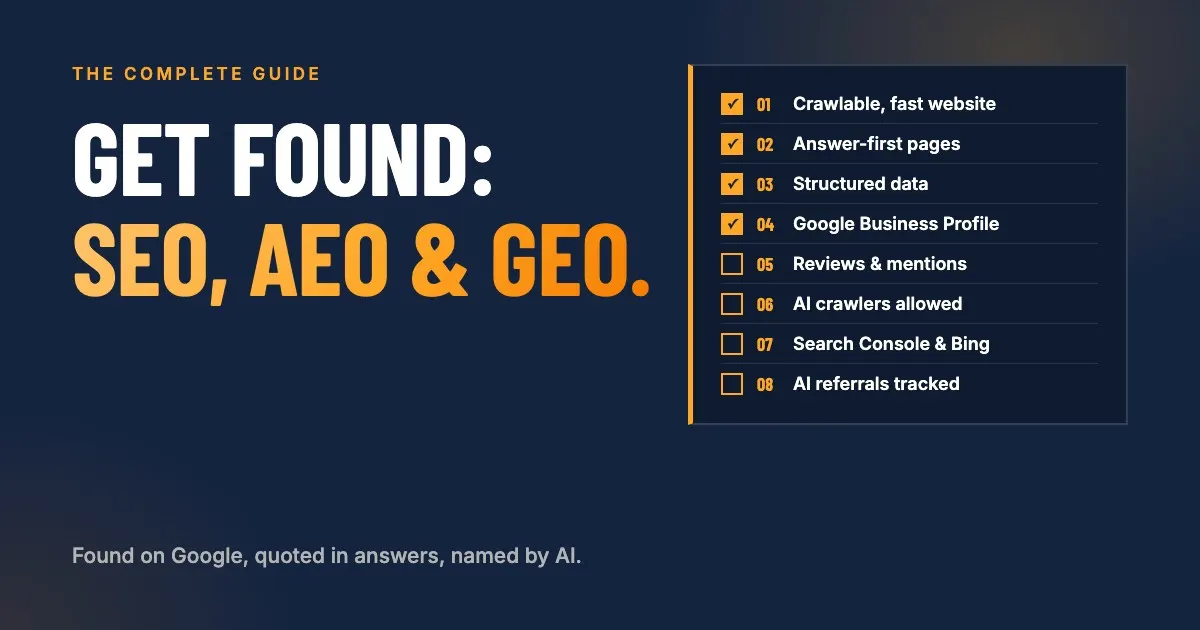
The short answer: SEO (search engine optimization) gets your website found and clicked on Google and Bing. AEO (answer engine optimization) makes your page the source of the direct answer that search engines show in featured snippets, voice search and AI Overviews. GEO (generative engine optimization) gets your business mentioned, cited and recommended when people ask AI assistants like ChatGPT, Perplexity, Gemini and Copilot who to hire. They are not three separate projects. They are three layers of the same work, built on the same foundations: a website search engines and AI can read, content that answers real questions clearly, and a business that the rest of the web confirms. SEO is the base, AEO shapes the content on top of it, and GEO extends the work beyond your own site. Do the foundations well and you are visible in all three places; skip them and no shortcut will save you.
Ask ten business owners how their customers find them and most will say “Google”. Ask how those customers decide, and the answer is changing. A homeowner looking for an insulation contractor might search Google, read the AI summary at the top, check the map, ask ChatGPT for a second opinion and only then call. Each step is a chance to be found or to be skipped.
This guide explains what SEO, AEO and GEO actually are, why they matter for a small business, how they fit together and what each one takes in practice. It ends with checklists, a 90-day plan and the questions to ask anyone who offers to do this work for you. It is long on purpose: this is the guide I wish every owner had read before paying for “SEO”.
What are SEO, AEO and GEO, in plain terms?
SEO, search engine optimization, is the practice of making your website easy for search engines to find, understand and trust, so it shows up high in the results when people search for what you do, and so they click. The unit of success is a ranking and a click.
AEO, answer engine optimization, is the practice of making your content the answer itself. More and more searches end with an answer on the results page: a featured snippet, a “People also ask” box, a spoken answer from a voice assistant or an AI Overview. AEO shapes your pages so a search engine can lift a clear answer from them, ideally with your name and a link. The unit of success is being the quoted source.
GEO, generative engine optimization, is the practice of being mentioned and recommended inside answers written by AI assistants. When someone asks ChatGPT “who are the best CRM consultants for small businesses?”, the assistant searches the web, reads a set of sources and writes an answer. GEO is about being one of those sources and one of the names in the answer. The unit of success is a citation or a recommendation.
You will also see other names: AIO (AI optimization), LLMO (large language model optimization) or “AI SEO”. They mostly describe the same thing as GEO. The labels matter less than the work.
Why do they matter for a small business right now?
Because the way people search has changed more in the last two years than in the ten before, while the number of searches has not gone down.
- Google is still where most searches happen. Google handles about 90% of search engine referrals worldwide, according to StatCounter, a share that has barely moved since 2024. Bing is a distant second at around 5%.
- AI answers now sit on top of those searches. Google said in May 2026 that AI Overviews reach more than 2.5 billion people a month, and that AI Mode, its conversational search, has passed 1 billion monthly users.
- AI assistants are a search channel of their own. ChatGPT reached 900 million weekly active users in February 2026, according to OpenAI, and Perplexity, Gemini and Copilot add many more.
- Fewer searches end in a click. A SparkToro study with Similarweb data found that 68% of Google searches in the US ended without a click in early 2026, up from about 60% in 2024 (the study changed data providers between the two, so read the trend, not the decimal). Pew Research found that when an AI summary appeared, people clicked a regular result in 8% of visits, against 15% without one.
- AI referrals are small but growing fast. Visits from AI assistants are still a small slice of website traffic, somewhere between 0.3% and 1% in most 2026 studies, but they have grown several times over in two years, and Google says clicks from AI Overviews tend to be higher quality, with people spending more time on the site.
Put together, this means two things for a small business. First, classic SEO still brings most of the traffic, so it cannot be dropped. Second, a growing share of decisions is made before anyone reaches your website: in an AI summary, a map pack or a chat. If your business is not part of those answers, you lose customers you never knew you had.
The good news is that this favours businesses that are clear, specific and trusted, which is often easier for a focused small business than for a large one.
Are SEO, AEO and GEO different things?
They are different goals on different surfaces, but they share most of their foundations. The easiest way to see it is side by side.
| SEO | AEO | GEO | |
|---|---|---|---|
| Goal | Rank and get the click | Be the answer that is shown | Be named and cited by AI |
| Where it shows | Google and Bing results, Google Maps | Featured snippets, People also ask, voice answers, AI Overviews | ChatGPT, Perplexity, Gemini, Copilot, Google AI Mode |
| What it rewards | Relevant pages, technical health, authority | Clear, direct, well structured answers | Trusted, consistent facts and mentions across the web |
| Main work | Your website and Google Business Profile | Your content and its structure | Your content plus your presence beyond your site |
| How you measure it | Rankings, clicks, leads from search | Featured answers, impressions, branded searches | Citations, AI referrals, what assistants say about you |
How do SEO, AEO and GEO fit together?
Think of them as three layers, each resting on the one below.
SEO is the foundation. If a search engine cannot crawl a page, does not index it or does not trust the site, nothing else happens. This matters for AI too: Google’s AI Overviews and AI Mode are built on Google’s search index, and Google says a page must be indexed and eligible to show a snippet to appear in them. Microsoft Copilot is grounded in Bing. ChatGPT runs its own search crawler alongside third-party search providers. Most AI answers start with a search.
AEO is how you write on top of that foundation. Once a page can be found, the question is whether it contains a clear answer worth showing. Pages that state the answer directly, under the question people actually ask, are the ones search engines quote and AI systems summarise.
GEO extends the work beyond your website. AI assistants do not only read your site. They compare what many sources say about you: directories, review sites, partners, articles, forums and social profiles. When those sources agree that you are a trusted specialist in something, you are far more likely to be named.
Google itself is blunt about this. Its guidance for site owners says there are no additional requirements or special optimizations needed to appear in AI Overviews or AI Mode, no special schema markup and no new AI text files, and that the best practices for SEO remain relevant. In other words: there is no secret GEO trick that replaces doing SEO properly. What GEO adds is attention to the parts of SEO that used to be “nice to have” and now carry much more weight: clear answers, consistent facts and your reputation beyond your own website.
What has not changed
Before going into each layer, it helps to name what stays constant, because many “new” tactics are old principles with a new label.
- Helpful, people-first content still wins. Google’s systems are designed to reward content written to help people, based on real experience and expertise, not content written to game rankings.
- Trust is earned, not declared. Google’s quality guidelines speak of experience, expertise, authoritativeness and trustworthiness (often shortened to E-E-A-T). AI assistants rely on similar signals: who you are, what you have done and who vouches for you.
- Spam still gets punished. Google’s spam policies cover mass-produced pages written to manipulate rankings, whether by people or by AI. Publishing hundreds of thin AI-written pages is a risk, not a strategy.
- The customer decides. Visibility only matters if it brings the right people to a page that makes it easy to call, book or buy.
SEO in detail: how do you get found on Google?
SEO has four parts: the technical foundations, the content on each page, the authority your site earns from others, and, for businesses that serve an area, local search.
Technical foundations
Search engines need to be able to reach every important page, read it quickly and understand how the site fits together.
- Crawling and indexing. Important pages must not be blocked in robots.txt or marked noindex. An XML sitemap lists them. In Google Search Console you can see which pages are indexed and why others are not.
- Speed and stability. Google measures real-world page experience with Core Web Vitals. A good result is Largest Contentful Paint (how fast the main content appears) within 2.5 seconds, Interaction to Next Paint (how fast the page responds to a tap) within 200 milliseconds, and Cumulative Layout Shift (how much things jump around) below 0.1.
- Mobile first. Google ranks the mobile version of your site. If it is hard to use on a phone, it is hard to rank.
- Secure and clean. HTTPS everywhere, one version of each page (with or without www, not both), redirects from old addresses to new ones and no broken internal links.
- Clear structure. Logical addresses, a navigation that reaches every service page within a few clicks, and breadcrumbs on deeper pages.
The platform you build on affects how easy all of this is. We compared the options in WordPress or a full AI website?
On-page content
Each important page should answer one clear intent: what someone searching for that topic wants to know or do.
- One topic per page. A page for each main service, and for each area you serve if location matters, rather than one page that lists everything.
- Titles and headings that match searches. The title tag and the main heading use the words your customers use, not your internal jargon.
- A clear description. The meta description does not affect rankings directly, but it is your advert in the results.
- Internal links. Related pages link to each other with descriptive text, so search engines and people can follow the topic.
- Images with purpose. Compressed images, descriptive file names and alt text that says what the image shows.
- A clear next step. A page that ranks but does not convert is a cost, not an asset.
Content that builds over time
Beyond service pages, a small number of genuinely useful guides can bring in visitors for years. The best ones answer the questions customers ask before they buy: what it costs, how long it takes, how to choose, what can go wrong. Group related content into clusters (a main guide with several supporting articles linking to it) so search engines see depth on the topics you want to own.
Write from experience. A contractor’s guide that says what they actually see on the job, such as which problems show up in older houses after a hard winter and how often, is more useful, and more quotable, than a generic article anyone could have written.
Authority and links
Search engines still treat links from other relevant, trusted sites as votes of confidence. For a small business, the most valuable ones usually come from real relationships: suppliers and partners, local associations and chambers, sponsorships, local news, industry directories, podcasts and guest articles. Buying links or joining link schemes breaks Google’s spam policies and is not worth the risk.
Local search
For any business that serves customers in an area, the Google Business Profile is often worth more than the website itself. Google says local results are based mainly on three things: relevance (how well the profile matches the search), distance (how far the business is from the searcher) and prominence (how well known the business is, including reviews, links, articles and directories). You cannot pay for a better local ranking.
- Complete every field: categories, services, hours, service area, photos and a description.
- Ask every happy customer for a review, and reply to every review, good or bad.
- Post updates regularly, especially offers and recent work.
- Keep your name, address and phone number exactly the same on your website, your profile and every directory.
SEO checklist
- Important pages are indexed (check the Pages report in Google Search Console)
- An XML sitemap is submitted to Google Search Console and Bing Webmaster Tools
- No important page is blocked by robots.txt or a noindex tag
- Core Web Vitals pass on mobile: LCP within 2.5 s, INP within 200 ms, CLS below 0.1
- HTTPS everywhere, one version of each address, old addresses redirected
- One page per main service (and per area served, where location matters)
- Titles and main headings use the words customers search for
- Every page has a unique title and meta description
- Related pages link to each other with descriptive text
- Images are compressed and have descriptive alt text
- Google Business Profile is complete, verified and active
- Reviews are requested after every job and answered
- Name, address and phone are identical everywhere
- Every page has a clear next step: call, book, request a quote
AEO in detail: how do you become the answer?
AEO starts with a simple observation: search engines increasingly show an answer, not just a list of links. Your job is to make your page the best source for that answer.
Where answers appear
- Featured snippets: the box at the top of Google that quotes a paragraph, list or table from one page.
- People also ask: expandable questions with short answers, each from a page.
- Voice answers: Google Assistant, Siri and Alexa read out one answer, usually from a featured result.
- AI Overviews and AI Mode: AI-written summaries that cite a set of supporting pages. Google says these systems use “query fan-out”: they run several related searches across subtopics and combine the results, which means a page can be cited for a sub-question even if it does not rank first for the main one.
How to write answer-first content
The structure that works is the one journalists have used for a century: the most important information first.
- Use the question as the heading. “How much does spray foam insulation cost?” rather than “Pricing”.
- Answer it directly in the first one or two sentences. Roughly 40 to 60 words that make sense on their own, without “as mentioned above”.
- Then give the detail. Factors, examples, exceptions and numbers.
- Use lists for steps and tables for comparisons. Search engines lift these formats readily, and readers scan them faster.
- Define terms the first time you use them. An answer engine may quote that one sentence out of context.
- Keep facts current. Prices, dates and statistics with a year attached are more trustworthy and more useful.
- Start important pages with a short answer. A two or three sentence summary at the top serves busy readers, search engines and AI alike. Every service page on this site starts that way.
Structured data
Structured data (schema.org markup) is code that tells search engines what a page is about in a format machines read: this is a business, here are its services, this is an article by this author, these are its questions and answers. Useful types for small businesses include Organization or LocalBusiness, Service, Article, Person, Product, Review and BreadcrumbList.
Two honest caveats. First, structured data helps machines understand a page; it does not guarantee any special display. Google has reduced several rich results over the years: FAQ and How-to rich results were cut back in 2023 and FAQ results have since stopped appearing in Google Search altogether. FAQPage markup is still valid and still describes your content, but do not add it expecting extra space in Google. Second, Google says no special markup is needed for its AI features, and markup must match what is visible on the page.
AEO checklist
- The real questions customers ask are listed (from calls, emails, sales conversations, “People also ask” and Search Console)
- Each important question has a heading on a relevant page, phrased as people ask it
- The answer comes first, in one or two sentences that stand on their own
- Steps are numbered lists; comparisons are tables
- Important pages start with a short summary answer
- Terms are defined the first time they appear
- Facts, prices and statistics carry a date and a source
- Organization or LocalBusiness, Service and Article structured data are in place and match the page
- Each page has one author or owner, with a page about them
- Featured snippets and “People also ask” for your main topics are checked quarterly
GEO in detail: how do you get named by AI assistants?
AI assistants answer a question in two broad ways: from what they learned during training, and from what they find when they search the web for that question (often called retrieval or grounding). For questions about current services, prices and “who should I hire”, the search step matters most, and it is the part you can influence.
How AI assistants find and choose sources
- They search first. Google’s AI Overviews and AI Mode use Google Search. Copilot uses Bing. ChatGPT uses its own crawler, OAI-SearchBot, alongside search partners. Perplexity runs its own crawler and index. If you are invisible in search, you are usually invisible here too.
- They compare sources. An assistant reads several pages and favours facts that several trusted sources agree on.
- They favour clear, specific, citable passages. Content with concrete facts, numbers, quotations and sources is easier to cite. A 2023 study by researchers at Princeton and partners (the paper that coined the term GEO) found that adding citations, quotations and statistics could raise a source’s visibility in AI answers by up to about 40%, while keyword stuffing did not help.
- They lean on your reputation beyond your site. An Ahrefs study of 75,000 brands found that the number of times a brand was mentioned on other websites correlated more strongly with appearing in Google AI Overviews than any other factor it measured, more than links.
What drives citations
Consistent facts about you. Who you are, what you do, for whom, where, since when and at what price level. Say it the same way on your website, your Google Business Profile, LinkedIn, directories and partner sites. Inconsistent facts make an assistant less confident about naming you.
Mentions on trusted sites. Reviews on Google and industry platforms, listings in respected directories, partner and supplier pages, local news, podcasts, industry associations and genuine participation in communities where your customers ask questions. The goal is not volume of links but agreement: many independent sources saying the same true thing about you.
Original, specific content. Your own data, case studies, prices, processes and opinions. An assistant has a hundred generic articles about “how to choose a web designer”. It has very few from a designer who can say how many sites they rebuilt last year, why the owners wanted to rebuild and what changed afterwards. That second kind is worth citing.
Freshness. Dates on articles, updated statistics and current prices signal that the information can still be trusted.
Access. If an assistant’s crawler is blocked, it cannot read you. Check your robots.txt and any firewall or bot protection your host applies.
Crawler access: who is who
Most small business sites should allow the search crawlers below. Training crawlers are a separate choice: blocking them keeps your content out of future model training, without removing you from search-based answers.
| Crawler | Company | What it does |
|---|---|---|
| Googlebot | Google Search, including AI Overviews and AI Mode | |
| Google-Extended | Controls use for training and grounding in Gemini and other Google AI products, not Search | |
| Bingbot | Microsoft | Bing search, which Copilot is grounded in |
| OAI-SearchBot | OpenAI | Shows sites in ChatGPT search answers |
| GPTBot | OpenAI | Collects content that may be used to train OpenAI’s models |
| ChatGPT-User | OpenAI | Visits a page when a ChatGPT user asks about it |
| PerplexityBot | Perplexity | Perplexity’s search index |
| ClaudeBot and Claude-SearchBot | Anthropic | Training and search for Claude |
What about llms.txt?
llms.txt is a proposed standard: a plain text file at the root of your site that summarises what the site is and links to its most important pages, written for AI tools. It is easy to add, and this site has one. But be realistic: Google has said it does not use llms.txt, studies of server logs show very few requests for it, and around one in ten sites had adopted it by mid-2026. Treat it as a small, cheap extra, never as a strategy.
Can you track what AI says about you?
Partly. You cannot see every conversation, but you can see a lot:
- Ask the assistants yourself. Once a month, put your customers’ real questions to ChatGPT, Perplexity, Gemini, Copilot and Google AI Mode. Record whether you are named, how you are described and which sources are cited.
- Bing Webmaster Tools has an AI Performance report (in public preview since early 2026) that shows how often your pages are cited in Copilot and Bing’s AI answers, and for which queries.
- Google Search Console includes traffic from AI Overviews and AI Mode in the Performance report, under the Web search type. It is not separated out, but it is counted.
- Your analytics show visits referred by chatgpt.com, perplexity.ai, gemini.google.com and copilot.microsoft.com. Group them into one AI channel so you can watch the trend. If you tag your own links, keep the rules in our UTM parameters guide.
- Your CRM should record how leads heard about you. Many people now answer “ChatGPT recommended you”.
GEO checklist
- One clear description of the business (who, what, for whom, where, since when) used everywhere
- Name, address, phone and website identical on all profiles and directories
- Google Business Profile, LinkedIn and key industry directories complete and current
- Reviews requested continuously on Google and the platforms your industry uses
- Mentions earned on partner, supplier, association and local news sites
- At least one piece of original, citable content per main service: data, a case study, a price guide or a clear opinion
- Statistics and claims carry sources and dates
- robots.txt and bot protection allow Googlebot, Bingbot, OAI-SearchBot and PerplexityBot
- A decision made, deliberately, about training crawlers like GPTBot and Google-Extended
- Bing Webmaster Tools set up, with the AI Performance report checked monthly
- AI referrals grouped in analytics as their own channel
- Monthly prompt checks recorded in a simple log
- An llms.txt file in place (optional, low effort)
What do you need to make all three work?
Checklists show the pieces. Here is what they add up to in terms of the website, the content, your presence beyond the site, measurement and ongoing work.
A website built to be read
The website does not need to be large, but it needs to be fast, crawlable, structured and easy to change. In practice that means: a page for each service, clear navigation, good Core Web Vitals, structured data, an XML sitemap, clean addresses and someone who can add a page or update a price within a day. A site that takes weeks to change cannot keep up with what search and AI reward. If your current site is slow, hard to edit or built on a pile of plugins, fixing that is often the first and most valuable step. Every site we build at Ímpetu starts with these foundations; see websites.
Content that answers the real questions
You do not need a blog post every week. You need the right pages:
| Page type | What it answers | Why it matters |
|---|---|---|
| Service pages | What do you do, for whom, how and at what price level? | The pages that rank for buying searches and convert |
| Location or area pages | Do you serve my area? | Local searches and map results |
| Pricing or cost guides | What will this cost me? | One of the most asked and most cited questions |
| Comparison pages | Which option is right for me? | High intent searches and AI “versus” questions |
| FAQ sections | The questions people ask before they call | Answers for snippets, voice and AI |
| Case studies | Have you done this before, with what result? | Proof for people, citable facts for AI |
| In-depth guides | Everything about one topic | Authority, links and long-term traffic |
| About and author pages | Who is behind this? | Trust for people and for machines |
A presence beyond your website
Your Google Business Profile, reviews, directories, social profiles, partner pages, associations and press coverage are where AI assistants confirm what your website claims. For many small businesses this is the most neglected part, and the one with the most room to gain.
Monitoring you will actually look at
Set up once, then check monthly:
- Google Search Console: impressions, clicks, positions and indexing.
- Bing Webmaster Tools: the same for Bing, plus AI citations in Copilot.
- Google Business Profile insights: calls, direction requests and website clicks.
- Analytics: organic visits, AI referrals and, most important, the leads they produce.
- A prompt log: what the assistants say about you, month by month.
Ongoing optimization
Search and AI visibility are not a launch; they are a habit. A realistic monthly rhythm for a small business:
| Every month | Every quarter | Every year |
|---|---|---|
| Check Search Console, Bing and analytics | Review rankings, featured answers and AI citations for main topics | Full technical audit |
| Run the prompt checks and log them | Update the most visited pages and their facts | Review positioning and service pages |
| Request and answer reviews | Add or improve one in-depth guide or case study | Refresh prices, statistics and dates across the site |
| Post on Google Business Profile | Earn two or three new mentions on trusted sites | Check directories and profiles for consistency |
| Fix anything broken or slow | Compare leads by source and adjust | Decide what to stop doing |
How long does it take, and what does it cost?
Time. Technical fixes, a complete Google Business Profile and structured data can show results within weeks. Ranking for competitive searches, winning featured answers and being cited by AI assistants usually takes three to twelve months, because it depends on content, reviews and mentions that accumulate. Anyone promising page one in 30 days is either working on searches nobody makes or taking risks with your site.
Cost. The main costs are the website foundations (often a one-off project), content (your time to share knowledge and someone’s time to write it well), reputation work (asking for reviews, building relationships) and monthly monitoring. Tools such as Google Search Console, Bing Webmaster Tools and Google Business Profile are free. Paid SEO platforms are useful at scale but not required to start. For most small businesses, the biggest cost is not money but consistency: doing the monthly work every month.
Which mistakes should you avoid?
- Chasing hacks instead of foundations. Hidden text for AI, special “AI files” sold as a fix, or tricks to “inject” your brand into chatbots. Google states plainly that no special optimization is needed for its AI features. The foundations are the strategy.
- Publishing AI content at scale. Hundreds of generic pages written by AI to cover every keyword can fall under Google’s spam policies and add nothing an assistant would want to cite. Use AI to help you write faster, not to write instead of knowing.
- Blocking the crawlers you need. Some hosts and security plugins block AI crawlers by default. Check.
- Ignoring the Google Business Profile. For local businesses it is often the most valuable listing they have.
- Inconsistent facts. Three different phone numbers and two old addresses across the web confuse search engines and AI alike.
- Keyword stuffing. It never worked well, and the Princeton GEO study found it does not help in AI answers either.
- Measuring traffic instead of leads. Ten visitors who call are worth more than a thousand who leave.
- Stopping after launch. A website optimized once and never touched again slowly loses ground to competitors who keep going.
Questions to ask before you hire someone for SEO, AEO or GEO
- What will you check first, and will I get the audit in writing, in plain language?
- Which of the three (SEO, AEO, GEO) do you cover, and how do they connect in your plan?
- How will you measure success, and will you report leads, not just rankings and traffic?
- Who writes the content, and how will you capture my experience and expertise in it?
- How will you build mentions and reviews, and will any of it involve buying links?
- Do you guarantee rankings or AI mentions? (The honest answer is no.)
- What happens to the work if we stop working together: do I keep the content, accounts and data?
- What does each month include, and what would cost extra?
- Can you show me a site, ideally your own, where you have done this?
A 90-day plan for a small business
If you want to start yourself, this order gives the most return for the effort.
Days 1 to 14: audit. Set up or check Google Search Console, Bing Webmaster Tools and analytics. List the 20 questions your customers ask most. Search them on Google and ask them in ChatGPT, Perplexity and Gemini, and note who is named. Check your robots.txt, your Core Web Vitals and your Google Business Profile.
Days 15 to 45: foundations. Fix indexing and speed problems. Make sure each main service has its own page with a clear title, a short answer at the top and a clear next step. Add Organization or LocalBusiness, Service and Article structured data. Complete your Google Business Profile. Align your name, address, phone and description everywhere.
Days 46 to 90: answers and reputation. Add the most asked questions to the right pages, answer first. Publish one in-depth, original guide on your most important topic. Ask your last 20 happy customers for a review. Earn two or three mentions on partner, association or local sites. Start the monthly prompt log and AI referral tracking.
After 90 days you will have the foundations in place, the first results in your reports and a clear picture of where the next quarter’s work should go.
How we do it at Ímpetu
We do this work for small businesses as part of their websites and marketing, and we do it on our own site first. This site has structured data on every page, short answers at the top of every service page, an llms.txt file, AI crawlers allowed, Search Console and Bing set up, and guides like this one built around the questions owners ask. If you want to see what that looks like for your business, see SEO & AI Visibility or book a call and we will look at how you show up today on Google and in AI assistants, and what we would fix first.
Sources
- Google Search Central: AI features and your website (no special optimization or markup needed, query fan-out, AI feature traffic in Search Console)
- Google Search Central: Creating helpful, reliable, people-first content and spam policies
- Google Search Central: Changes to HowTo and FAQ rich results
- Google Business Profile Help: How to improve your local ranking on Google (relevance, distance and prominence)
- web.dev: Core Web Vitals (thresholds for LCP, INP and CLS)
- Dataconomy: Google says AI Overviews reach 2.5 billion monthly users (Google I/O, May 2026)
- TechCrunch: ChatGPT reaches 900M weekly active users (February 2026)
- Search Engine Land: Google zero-click searches, 2026 study (SparkToro and Similarweb)
- Pew Research Center: Google users are less likely to click on links when an AI summary appears in the results (July 2025)
- SE Ranking: Analysis of top AI search engines and referral traffic (AI share of website traffic)
- Ahrefs: An analysis of AI Overview brand visibility factors, 75K brands studied
- Aggarwal et al.: GEO: Generative Engine Optimization (Princeton and partners, KDD 2024)
- OpenAI: Overview of OpenAI crawlers (OAI-SearchBot, GPTBot, ChatGPT-User)
- Search Engine Land: Bing Webmaster Tools AI Performance report
- StatCounter: Search engine market share worldwide
FAQ
Frequently asked questions
What is the difference between SEO, AEO and GEO?
SEO (search engine optimization) gets your pages found, ranked and clicked in search results such as Google and Bing. AEO (answer engine optimization) makes your page the source of the direct answer in featured snippets, voice search and AI Overviews. GEO (generative engine optimization) gets your business mentioned, cited and recommended in AI assistants such as ChatGPT, Perplexity, Gemini and Copilot. They build on the same foundations, so the work is done together.
Is SEO dead because of AI search?
No. Google still handles about nine out of ten searches worldwide, and AI Overviews and AI Mode are built on Google's search index, so a page that is not indexed and trusted in search is unlikely to be used in an AI answer. Google says the best practices for SEO remain relevant for its AI features. What has changed is that fewer searches end in a click, so being the answer and being named matter more than before.
Do I need special markup or files to appear in AI Overviews?
No. Google says there are no additional requirements or special optimizations for AI Overviews or AI Mode, and no special schema.org markup or AI text files are needed. A page must be indexed and eligible to show a snippet. Structured data still helps search engines understand your business and content, as long as it matches what is visible on the page.
How do I get my business mentioned by ChatGPT?
Make sure ChatGPT can find you and has good reasons to trust you. Allow OpenAI's search crawler, OAI-SearchBot, in your robots.txt, describe your business the same way everywhere, earn mentions and reviews on other trusted sites, and publish specific, original answers to the questions your customers ask. There is no guarantee, but these are the signals AI assistants rely on.
Does llms.txt help with AI search?
Possibly a little, but nobody should count on it. llms.txt is a proposed standard that gives AI tools a plain summary of a site. Google has said it does not use it, and server log studies show few requests for it. It takes minutes to add, so it does no harm, but crawler access, clear content and mentions on other sites matter far more.
How long does SEO, AEO and GEO take to work?
Technical fixes and Google Business Profile improvements can show within weeks. Rankings for competitive searches, featured answers and AI citations usually build over three to twelve months, because they depend on content, reviews and mentions that accumulate. Expect to judge the work quarter by quarter, not week by week.
How do I measure visibility in AI assistants?
Use four sources together: Google Search Console (AI Overviews and AI Mode traffic is included in the Performance report), the AI Performance report in Bing Webmaster Tools for Copilot citations, visits from chatgpt.com, perplexity.ai, gemini.google.com and copilot.microsoft.com in your analytics, and regular checks of what the assistants say when you ask them your customers' questions.
Can a small business compete with big brands in AI answers?
Often, yes, especially for local and specialist questions. AI assistants look for the most relevant, best supported answer, and for a question like who repairs spray foam insulation near Green Bay, a well described local business with reviews and clear service pages can beat a national brand. Specific, first-hand content is the small business advantage.
Should I block AI crawlers to protect my content?
Only if you are willing to give up visibility. Blocking a search crawler such as OAI-SearchBot or PerplexityBot can keep you out of that assistant's answers. You can treat training and search separately: OpenAI, for example, lets you block GPTBot (training) while allowing OAI-SearchBot (search). For most small businesses that want customers, allowing search crawlers is the better choice.

Written by
Konstantin von BrockeFounder of Ímpetu Consulting. Konstantin is a fractional marketing manager for small businesses and nonprofits: he leads the plan, the work and the people, and builds the tracking that shows what pays off.